Springs · St. Jacobs
Extension Spring Replacement in St. Jacobs
A bang like a dropped toolbox came from the garage last night.
In plain words
Extension springs are common on the detached garages behind older houses, where a low ceiling left no room for a torsion shaft, and those garages are rarely heated. Damp summers, hard frosts and salt carried in on the car pit the spring wire over the years, and a fatigued spring most often lets go on a cold morning when the steel is stiffest. Replacement fits a new pair rated for the door, renews the pulleys and cables that have rusted alongside them, adds containment cables where the original installation never had any, and leaves a door that lifts easily by hand when the power is out.
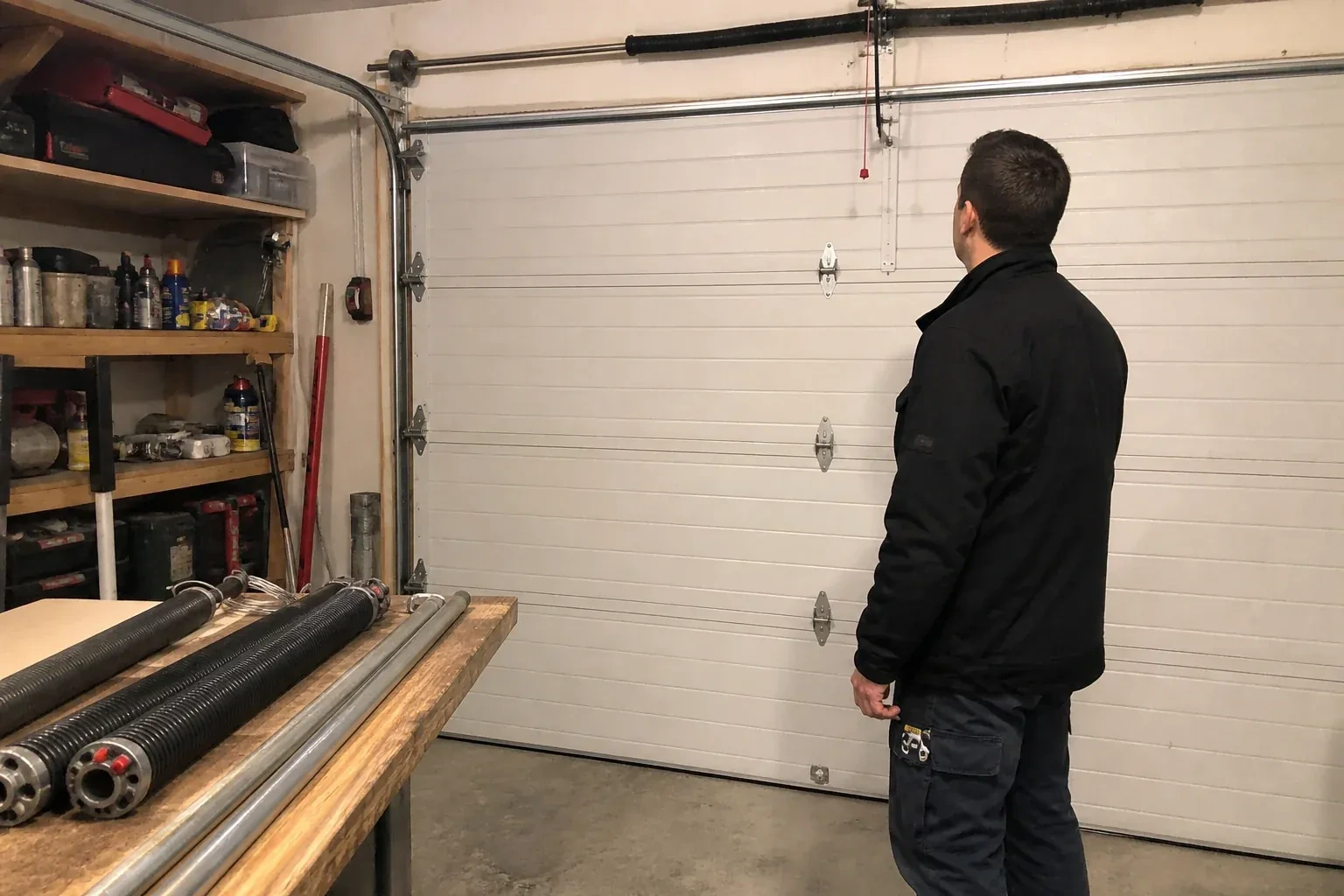
How the visit goesA bang like a dropped toolbox came from the garage last night. This morning one of the long springs beside the track hangs in two pieces, and the door will only rise a few inches before the opener gives up and stops.
Extension Spring Replacement
How the visit goes
Torsion or extension, and which extension layout
The technician confirms the counterbalance type before choosing any part. Extension springs hang beside the horizontal tracks, one each side, with a pulley on the front end of each spring and a second, fixed pulley on the track angle near the door opening; the lift cable runs from the bottom corner over both. A torsion system has a spring on a shaft above the opening and belongs to a different service. Extension systems also vary: single or double springs per side on heavier doors, hangers fixed to the ceiling or to the rear track support, and cables that adjust at an S-hook, a clip or an eyebolt. Each affects the parts brought to the job.
Running the lift cables
Each lift cable starts at the bottom bracket, where its loop goes over the pin or is secured with a clevis pin. From there it runs up the vertical track, over the fixed pulley at the front of the horizontal track, back along the track to the pulley on the end of the spring, around it, and forward again to the S-hook or adjusting clip at the front hanger. The technician keeps the cable seated in each pulley groove and makes sure it passes on the correct side of the containment cable and the track. Cables are renewed if the old ones showed any fraying or rust, and always as a pair of the same length.
A clear threshold and an honest opener
Two habits protect the new springs from the shocks that shorten a spring's life. The first is the floor: a door that comes down on a bin, a bike wheel or a ridge of packed snow stops short while the springs and cables are still pulling, and the jolt can throw a cable off its pulley. Keep the opening clear and scrape the ice ridge off the threshold before running the door in winter. The second is the opener's force setting. It was set for the newly balanced door; if the door ever seems to need more push, that is the springs asking for attention, not a reason to turn the force up.
Extension Spring Replacement
In the van
Track clamps or locking pliers
Door-weighing scale
Garage-door spray lubricant
S-hooks and adjusting clips
Pulleys (sheaves) and forks
Extension Spring Replacement
What affects the quote
Containment cables to add
A door that never had containment cables gets them with the new springs, along with anchor hardware into the framing. It is a small parts line and a worthwhile one.
Rollers, hinges and bottom brackets found worn
Cracked roller wheels, split hinges or a bottom bracket rusted at the cable pin are pointed out during the inspection and offered as optional items, since the door is already open and secured.
Converting to torsion instead
Where the garage has the headroom, some owners take the opportunity to move to a torsion system. That is a different job with different hardware and is quoted as its own option.
What to have ready
- Is there anything stored beside the tracks or under the springs?
- Is the door closed, fully open, or stuck partway?
- Is a spring broken in two, hanging loose, or just looking stretched?
Extension Spring Replacement: questions
QuestionsWill the lift cables be changed as well?
They are inspected every time and changed when they show fraying, rust at the bottom loop, or a kink from having jumped a pulley. Cables and springs are generally the same age, and with the door already open and the springs off, fitting new cables adds little to the visit. Bright, tight strands with clean loops can stay and are simply re-routed over the pulleys and set to the new springs.
What does the paint colour on the end of the spring mean?
Manufacturers dab a colour on the end coil to indicate the spring's weight rating, which is a handy starting point. It is not the final word: a faded or repainted end coil tells you little, and the pair on an older door may have been a near match rather than the right one. The technician treats the colour as a hint and confirms the rating from the door's measured weight and the spring's own dimensions.
Would a stronger spring make the door easier to lift?
Not in a useful way. The aim is a spring that matches the door's weight, so the door holds still wherever you leave it. A spring rated above that weight pulls the door up on its own, makes it hard to close, and leans on the opener to hold it down. A spring rated below lets it sink. Matched springs, set to the same hook position, give the light, even feel you want.
Related services
- Garage Door Hinge ReplacementOn the old wood door, one hinge has pulled away from the panel, dragging a screw and a chunk of soft timber with it.
- Garage Door Track Repair or ReplacementAfter a decade of slushy winters the bottom foot of the track is flaking rust.
- Garage Door Cable ReplacementThere was a sharp crack from the garage, and when you went to look the door had dropped on one side and jammed.